NBHAA Historical Articles
THE SCHWINN BLACK PHANTOM!
By Leon Dixon
Copyright © 1984, 1998, 2004, 2007 by NBHAA and L. Dixon, All rights reserved.
With the Black Phantom now reproduced and the favorite of nearly all collectors, we figure that some of you out there might enjoy the following...
AUTHOR'S NOTE REGARDING COPYRIGHTS:
Copyright © 1984, 1998, 2004, 2007 Leon Dixon, all rights reserved
This article originally was written for now-defunct CYCLIST magazine and appeared in the December, 1984 issue of that magazine. This was the first major bicycle magazine (news stand publication) to ever feature a story on the Schwinn Phantom. (NOTE: The very first such magazine article to include the Phantom for collectors was also written by yours truly in 1977 and appeared in the January, 1978 issue of Popular Mechanics magazine...haunt your libraries, folks! For our Spanish speaking friends, the article appeared en Espanol in April, 1978 Latin American/European edition of PM and was entitled, Restaure Su Bicicleta! There was also a French version, but I have forgotten when it appeared). All photos in the Cyclist magazine Concours 'd Elegance series for articles written by your curator were taken by my good friend and noted photographer, Steve Essig (subsequent Brand-X articles follwed using the name we established these were neither written by us, nor did they use our information). Although photo copyrights originally were listed in the magazine as Steve's they in fact are assigned to Leon Dixon as per agreement with Steve Essig. No part of this article or the original article may be reproduced or excerpted without written permission of the author.
AUTHOR'S NOTE REGARDING THE SCHWINN BLACK PHANTOM IN THE ACCOMPANYING PHOTOS.
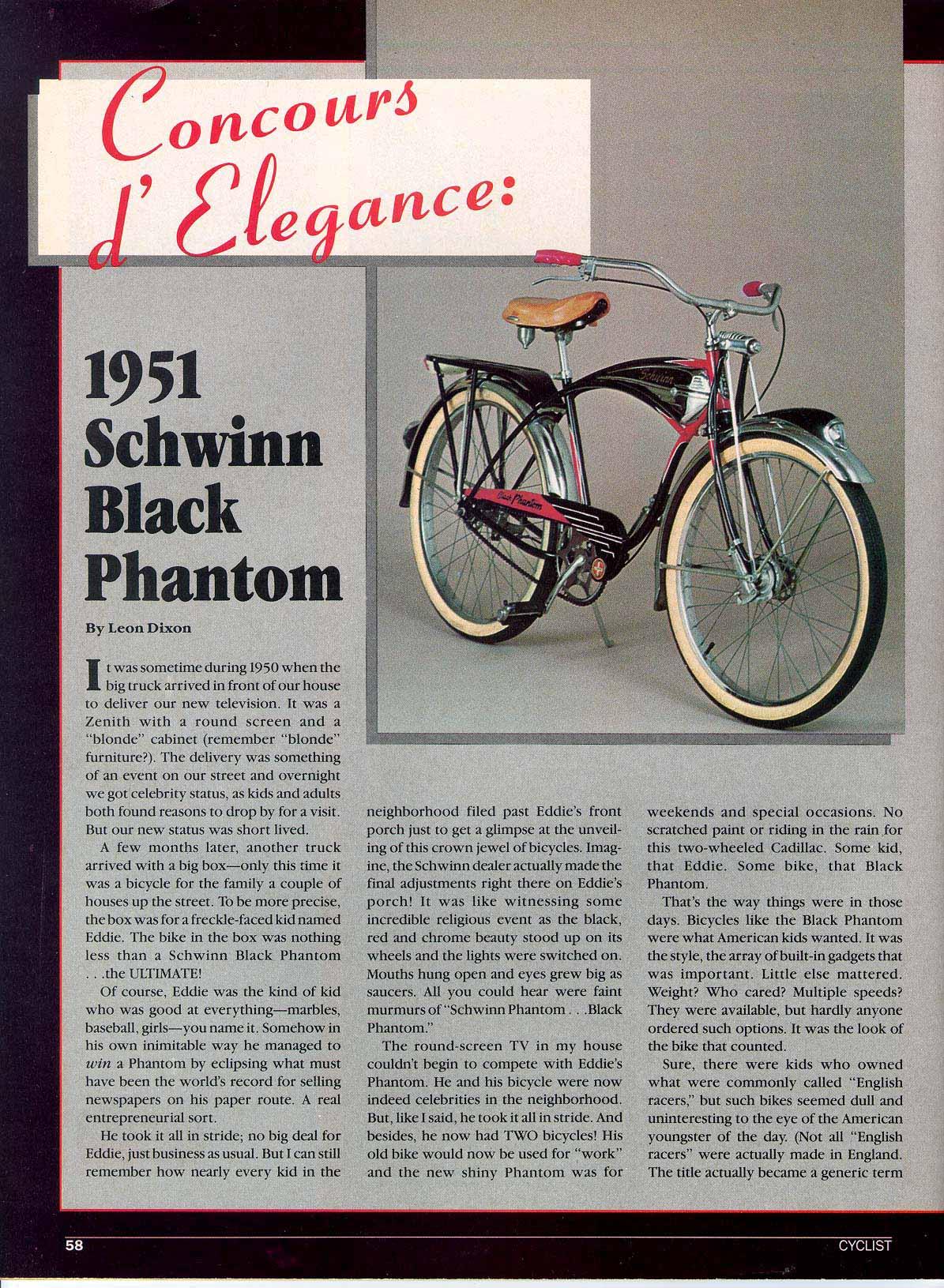
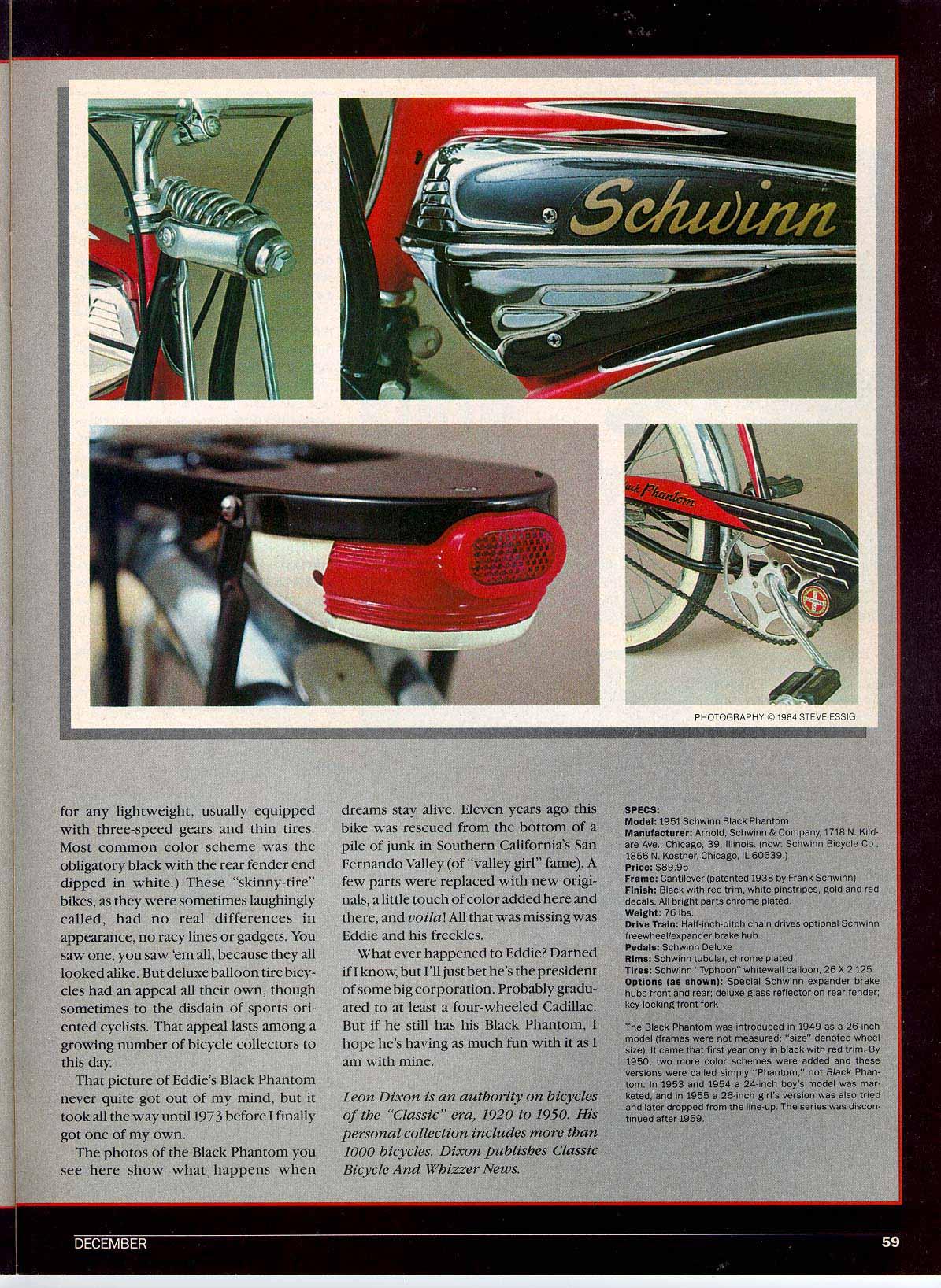
These are the original photos used in the 1984 article. The photos had (obviously) been taken well prior to the time of the article. This particular Phantom belongs to the author and was perhaps the first Black Phantom ever fully restored (having been completed by about 1972-73). There are absolutely no reproduction parts on this bicycle and all chrome is original except for the handlebar stem. Likewise, decals are all original. This bicycle is shown in the accompanying photos with a pinstripe missing on the tank (just never got around to doing it by the time the pics were taken), however this was corrected later. The screw heads on the tank should actually be slotted type, although Phillips type screw heads were installed at the time of the photo (this was also corrected later). Also the Schwinn Chicago seal decal had not yet been applied to the seatpost and thus is missing in the photo. Finally, although the pinstripe on the lower down tube appears to extend underneath the tube, it actually does not. Other restored Phantoms have mistakenly carried this line through to connect (even posters and magazines in more recent years have shown the strip fully connected underneath), but the factory never joined these stripes as such. Imperfections of the stripe in the photos accompanying this article on this site may appear either grainy or slightly wiggled...however this is an optical illusion created in the scanning process. We can assure you that the actual bicycle has excellent pinstripes...
It was sometime during 1950 when the big truck arrived in front of our house to deliver our new television. It was a Zenith with a round screen and a "blonde' cabinet (remember "blonde" furniture?). The delivery was something of an event on our street and overnight we got celebrity status, as kids and adults both found reasons to drop by for a visit. But our new status was short lived.
A few months later, another truck arrived with a big box...only this time it was a bicycle for the family a couple of houses up the street. To be more precise, the box was for a freckle-faced kid named Eddie. The bike in the box was nothing less than a Schwinn Black Phantom . . .the ULTIMATE!
Of course, Eddie was the kind of kid who was good at everything: marbles, baseball, girls, you name it. Somehow in his own inimitable way he managed to win a Phantom by eclipsing what must have been the world's record for selling newspapers on his paper route. A real entrepreneurial sort.
He took it all in stride; no big deal for Eddie, just business as usual. But I can still remember how nearly every kid in the neighborhood filed past Eddie's front porch just to get a glimpse at the unveiling of this crown jewel of bicycles. Imagine, the Schwinn dealer actually made the final adjustments right there on Eddie's front porch! It was like witnessing some incredible religious event as the black, red and chrome beauty stood up on its fat whitewall tires and the lights were switched on. Young mouths hung open and eyes grew big as saucers. All you could hear were faint murmurs of "Schwinn Phantom . . . Black Phantom."
The round screen TV in my house couldn't begin to compete with Eddie's Black Phantom. The mantle had been passed. As far as any kid in the area was concerned, Eddie and his bicycle were now indeed the new celebrities in the neighborhood. But, like I said, he took it all in stride. And besides, he now had TWO bicycles! His old bike would now be used for "work" and the new shiny Phantom was for weekends and special occasions. No scratched paint or riding in the rain for this two wheeled Cadillac. Some kid, that Eddie. Some bike, that Black Phantom.
That's the way things were in those days. Bicycles like the Black Phantom were what American kids wanted. It was the style, the array of built-in gadgets that was important. Little else mattered. Weight? Who cared? Multiple speeds? They were available, but hardly anyone ordered such options. It was the look of the bicycle that counted.
Sure, there were kids who owned what were commonly called lightweight "English racers," but such bicycles seemed dull and uninteresting to the eye of the typical American youngster of the day (not all "English racers" were actually made in England. The title actually became a generic term for any lightweight, usually equipped with three-speed gears and thin tires. Most common color scheme was the obligatory black with the rear fender end dipped in white.) These "skinny-tire bikes", as they were sometimes laughingly called, had no real differences in appearance, no racy lines or gadgets. You saw one, you saw 'em all, because they all looked alike. But deluxe balloon tire bicycles had an appeal all their own, though sometimes to the disdain of sports oriented cyclists. That appeal lasts among a growing number of bicycle collectors to this day. But we digress.
That picture of Eddie's Black Phantom never quite got out of my mind, but it took all the way until 1972 before I finally got one of my own (prior to that I had pieces of one, but not a complete Phantom). The photos of the Black Phantom you see here show what happens when dreams stay alive.
Twenty-six years ago this bike was rescued from the bottom of a pile of junk at a used bicycle store that once existed in Southern California's San Fernando Valley (of "valley girl" fame). It was in fact a real Black Phantom and not something assembled out of parts to look like one. A few parts were replaced with new originals, a little touch of color added here and there, and voila! All that was missing was Eddie and his freckles.
What ever happened to Eddie? Darned if I know, but I'll just bet he's the president of some big corporation. Probably graduated to at least a four-wheeled Cadillac. But if he still has his Black Phantom, I hope he's having as much fun with it as I am with mine.
Leon Dixon is an authority on bicycles of the "Classic" era, 1920 to 1950... a classification which he coined, defined and copyrighted the definition (one example of which was published in November, 1979 Bicycle Dealer Showcase magazine). He was the first to actively collect and restore these bicycles and first to write about them. His personal collection includes more than 1000 bicycles. Dixon is curator of National Bicycle History Archive of America, Box 862 Gig Harbor, WA 98335
SPECIFICATIONS:
MODEL: 1951 Schwinn Black Phantom
MANUFACTURER: Arnold, Schwinn & Company, 1718 N Kildare Ave., Chicago, 39, Illinois. (now Schwinn Cycle & Fitness Co. Boulder, CO.)
ORIGINAL PRICE: $89.95
FRAME: Cantilever (design patented 1938 by Frank Schwinn)
FINISH: black enamel with red trim, white pinstripes, gold and red decals. All bright parts chrome plated.
WEIGHT: 76 Ibs.
DRIVETRAIN: 1/2-inch-pitch chain drives optional Schwinn freewheel/expander brake hub. (NOTE: normally a conventional coaster brake was installed)
PEDALS: Schwinn Deluxe
RIMS: Schwinn tubular, chrome plated
TIRES: Schwinn 'Typhoon" whitewall balloon, 26 x 2 125
OPTIONS: (as shown): Special Schwinn expander brake hubs front AND rear; ...deluxe glass reflector on rear fender;....
A FOOTNOTE...
The Black Phantom was introduced in 1949 as a 26-inch boy's model (frames were not measured; Size denoted wheel Size). It came that first year only in black with red trim. Despite recent information which has appeared in books, magazines and the internet, this first model differed greatly from all other Phantoms in numerous ways. By 1950, two more color schemes were added and these versions were called simply "Phantom", not Black Phantom. All early Phantoms had a special key-locking front fork designed to prevent theft. This lock became optional later in the series. In 1953 and 1954 a 24-inch boy's model was marketed for a time, and in 1955 a 26-inch girl's version was also tried and later dropped from the line-up. The Phantom series was discontinued after 1959, briefly reappearing on a BMX style bicycle in the early 1980s. More recently the new Schwinn organization has reproduced the Black Phantom and a number of other Phantoms in other color Schemes. We will go much further into detail on the matter in our upcoming book on classic bicycles and their history.
QUESTIONS FOR PHANTOM PHANATICS OUT THERE...
1.) WHAT ARE 2 OF THE MOST RARE OPTIONS FOR SCHWINN PHANTOM? WHEN WERE THESE OPTIONS AVAILABLE?
2.) THERE IS A MAJOR MUSEUM SOMEWHERE IN AMERICA DISPLAYING A "1951 SCHWINN BLACK PHANTOM". THIS SAME PHANTOM HAS APPEARED IN PUBLICATIONS VARIOUSLY DATED AS "1949" OR "1950". WHAT REAL YEAR IS THIS PARTICULAR SCHWINN BLACK PHANTOM?
3.) WHEN WAS THE FEMALE PHANTOM VERSION MADE AND WHICH BROCHURE ACTUALLY SHOWS IT?
3.) WHO WAS THE FIRST TO WRITE ABOUT AND AUTHENTICALLY RESTORE A SCHWINN BLACK PHANTOM? AND WHEN AND WHERE WAS THIS DONE?
4.)WHO OUT THERE HAS ABSOLUTE, VERIFIABLE PROOF OF A BLUE MALE PHANTOM BICYCLE?
Thank you for visiting the NBHAA Historical articles! This section will change as time goes on, but will continuously feature rare glimpses at bicycle history, memorabilia and facts you won't find anywhere else. We will eventually be posting the entire series of CYCLIST magazine articles that were written by your curator in the 1980s. We hope you enjoy the photos and information. And stay tuned !

This page, all design and contents, all photos unless otherwise noted are Copyright © 1984, 1998, 1999, 2004, 2007 by Leon Dixon/NBHAA, All rights reserved.
Date of last update to this page: 22 OCTOBER 2007

Top of this Page
Back to Gallery Page 1
Back to NBHAA Home Page